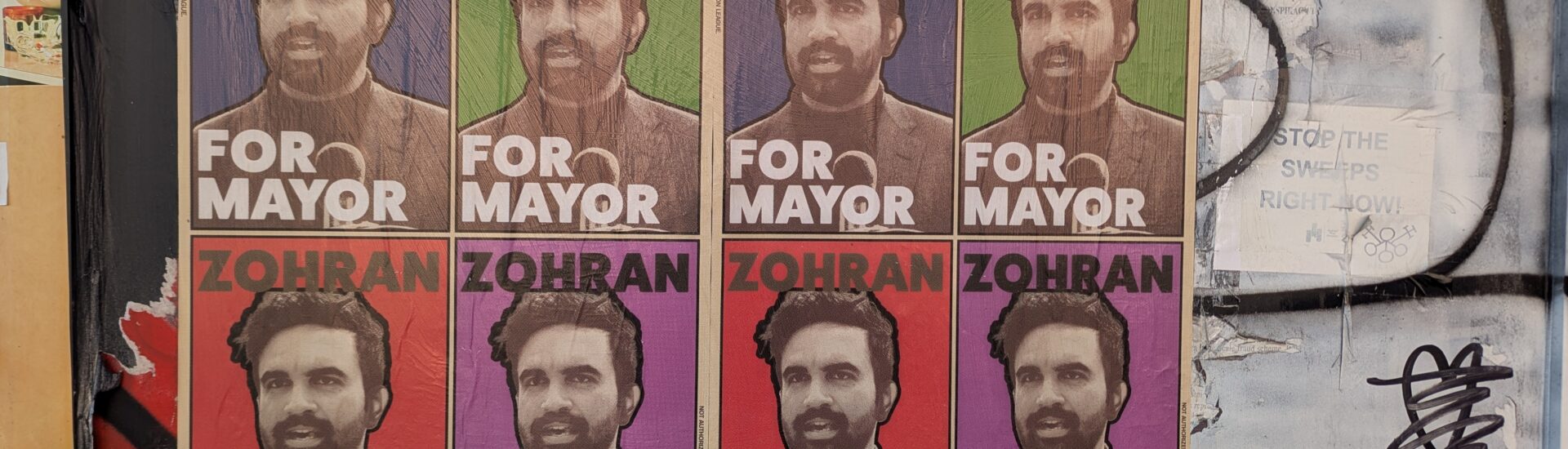

Mamdani Wins the NYC Mayoral Race
Earlier this week, on 11/4/2025, Zohran Mamdani won the race for New York City Mayor. An expected but dystopian outcome that exemplifies the failings of American democracy.
The Fall of Eric Adams

Image Source: “Subway Safety” by Metropolitan Transportation Authority, CC BY 2.0
A lax federal stance on illegal immigration from January 2021 to January 2025 resulted in border states taking matters into their own hands. These states settled upon the simple and effective solution of paying for the transportation of migrants out of border towns to so called “sanctuary cities”. New York City was one of the destinations of choice and in accordance with its “right to shelter” law, was legally mandated to provide indefinite shelter and basic necessities to all homeless/migrant individuals who requested it. With the city overwhelmed by the influx in immigrants they were legally required to support, Mayor Eric Adams sent out requests to the state and federal government for financial assistance. With his cries for help ignored he went public with his budgetary concerns and spoke out against the Biden Administration and federal immigration policy as a whole.
Having a Democrat mayor speak out about poor party policy was a valuable political chip for Republicans nationwide. In making the presidential administration look foolish, Adams found himself the target of said administration’s favorite political tool, lawfare. Indicted by the Southern District of New York, Adams was accused of receiving an unacceptable amount of travel upgrades from Turkish officials and businessmen, in exchange for expedited fire approval of a new Turkish consulate building. Although the case was dismissed in April of 2025, Adams’ divergence from the “go along to get along” strategy of the Democratic party left him politically stranded. So, when it came time to run for re-election, Eric Adams found himself without the support of the party.
Democratic Nominee
With Eric Adams’ tainted, the democrats held a primary to determine their new mayoral candidate. Enter Zohran Mamdani, a self-proclaimed “democratic socialist” whose main talking points are freezing rent, taxing the rich, free bus rides, free child care, city-owned grocery stores, reduced police presence, and a move away from prisons.
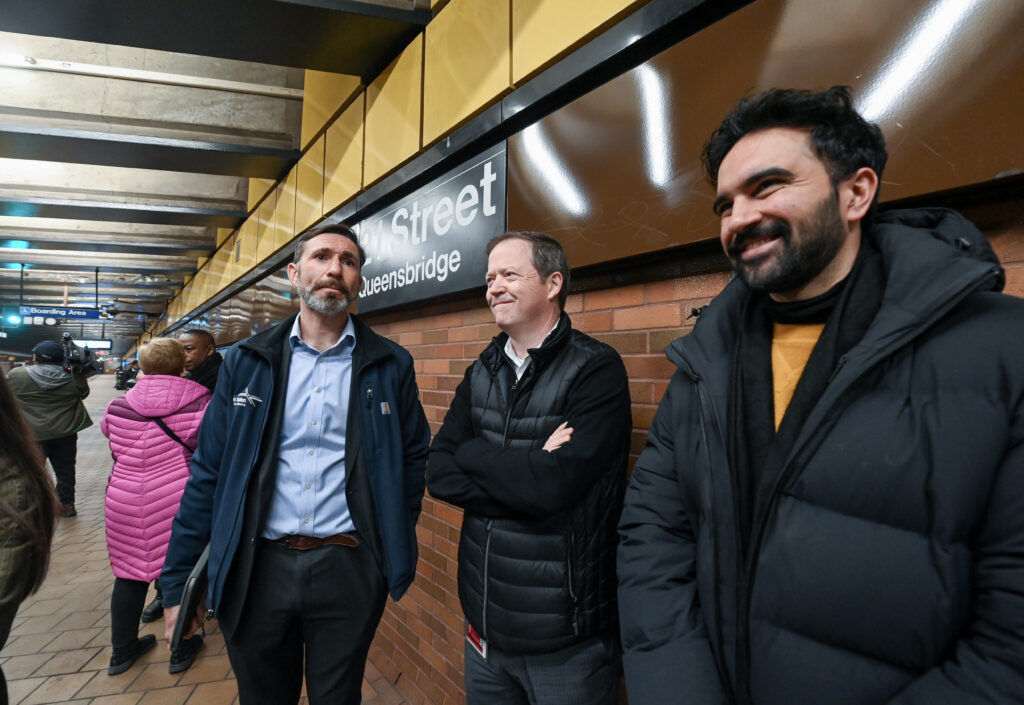
Mamdani on Right. Image Source: “63 St Corridor” by Metropolitan Transportation Authority, CC BY 2.0
His closest competitor in the Democratic Primary was disgraced New York Governor, Andrew Cuomo. Andrew is most known for his mishandling of nursing homes during the Covid 19 pandemic and the sexual harassment allegations that led to his resignation as governor.
Typically, Mamdani type figures are laughed off the stage and people hold their nose as they vote for real politicians like Cuomo. However, facing a collective IQ problem as a result of financial strain brought about by the pandemic, New York Democrats decided to vote for the guy who said he would give them free things and Mamdani won the primary.
Blue No Matter Who
As the democratic nominee, Mamdani ran against Cuomo (who decided to run as an independent), Eric Adams (who ran as independent but ended up dropping out and endorsing Cuomo), and Curtis Sliwa.
Sliwa is known for founding the Guardian Angels, a citizen vigilante group focused on fighting New York City crime in the 1980s. He is also known for his love of animals: owning 17 cats and campaigning against kill shelters. I did not bother further familiarizing myself with him because unfortunately, Curtis wears a beret (the calling card of the Guardian Angels) and is a republican.
Enter the main fail point of American democracy, partisan politics. Voting is hard and to make the process easier, tribalism was introduced in the form of political parties. Aligning yourself with a tribe absolves you of the necessity to use your brain when making decisions. With this simple trick you do not have to assess candidates so much as figure out if they are of your tribe or not, typically indicated on a ballot as one of the three: Democrat, Republican, or Independent (a catch-all field for non-serious candidates). This turns what would be a complex process of analysis of policy and character into a literacy test which can happen as late as the voting booth.
By allowing for more range within parties than across parties you are able to sort 340 million unique citizens into one of three boxes, with most proudly identifying as Blue or Red. That is American democracy in action. The commitment to a color and then the ongoing justification of said color. The system usually resulting in 2 career politicians in competition for the top job.
Partisan individuals are often those proudest to identify as voters, drowning a room with their political opinions. The irony of this being that their votes are often meaningless as there is nothing less democratic than partisan politics. When you force people into boxes, and have them strongly committed to said boxes, the boxes end up with all the power. When a city like New York is primarily occupied by “Blue No Matter Who” voters, the Red and Independent voters may as well shred their ballots. This supremacy by Blue is cheered by their constituents but the reality of the matter is that their votes become equally meaningless. My ability to look at you and tell you who you are going to vote for based on a pool of candidates I have selected is not something to take pride in. In “Blue No Matter Who” cities and states the Democratic party is the only party selecting candidates. The race is decided before you have walked into the voting booth.
Curtis Sliwa and Andrew Cuomo never stood a chance.
Criticism of Mamdani
The criticism of Mamdani results from that which makes him popular, his youth and the ignorance of culture that comes with it. At 34 years old, he does not bring a great deal of political wisdom to the table. His populist campaign rhetoric, while delivered with extreme passion, often looks ugly on paper. It is not real politics; it is something you would hear from a student running for class president. The pandering to economically disenfranchised people and vilification of the economically powerful is more akin to economic experimentation than genuine political policy. In making enemies of the useful to win over the many he has burned a lot of people who are crucial for executing his vision. Something that he seems to be completely fine with, which is extremely concerning.
A great example of this is his primary campaign promise, rent freezes to combat housing unaffordability. New York City is the most competitive city in the world, so housing is naturally expensive. Although Mamdani’s anti-landlord rhetoric may energize those struggling to make rent, it alienates those struggling to be landlords. Because there are more renters than landlords, you can use this platform to win, but you cannot use it to govern. You need the help and cooperation of landlords to fix the housing crisis. Simply freezing the rent will only worsen the supply/demand imbalance in instances of housing shortage. Mamdani’s solution to that? Asset seizures, something that merely transfers the burden to the city. It is possible that his lack of experience has given him the impression that he will have dictatorial powers as mayor and when he does not receive them will throw a political temper tantrum on the world stage, inciting political violence.
Consequences
I am not so foolish as to claim I have the power to see the plagues to come as a result of Mamdani’s victory. The probability tree is vast and I am neither an expert in what he will attempt to do nor what he will have the power to do. Furthermore, if the observation of politics has taught me anything, it is that even what appears to be straightforward is often a tooth and nail fight. Politicians overpromise, change their minds, re-prioritize, and most importantly, are in competition with themselves and others to build a lasting legacy. Put succinctly, all battles in politics are uphill. The secret? Find your opponent’s flank. Attack what is unguarded. Move quietly, taking the ground you can before you are spotted, and holding what ground you have gained. Do not tell that to Mamdani though, let him continue to bask in the light of victory, forsaking any temperance adopted to achieve it, before he sees the shadow of the city he is tasked with lifting.
Will he find a way to significantly raise taxes?
I have no clue. When the American populace wore the pants in the relationship with their government, increased tax revenues were something to be critical of. However, as their relationship with government evolved toward “Social Safety Nets” and Keynesian economics, the power dynamic shifted, and the populace took to the back seat. Americans used to view themselves as check writers and the government as an employee, one whose job was to work for them and would be fired if it performed poorly in its function. Today, a great deal of Americans quite literally look to the government for their paycheck.
Increased economic dependency on the government has changed American sentiment toward increases in tax revenues, especially if such taxes are proposed to target an “other”. In fact, taxation based on racial identity has been gaining ground as a movement on university campuses. A modern means of segregation, these proposals group otherwise unrelated individuals based on their genetically inherent characteristics and use blunt economic instruments to hammer the unpopular. Put so plainly, most would find this idea repulsive. However, when pitched as a way of “leveling the playing field” for disadvantaged groups, such measures easily win over the self-loathing youth, misdirected by an underdeveloped moral compass.
All this to say, people have grown willing to look the other way of heinous breaches of justice if it means an increase in tax revenues. I would not be surprised if Mamdani were open to testing the limits of his power when it comes to raising revenues, likely with the parallel goal of agitating select, unpopular groups.
Will the wealthy leave the city?
The wealthy are unlikely to leave New York City in significant numbers. In New York, you have a lot of dumb money, high incomes, inherited wealth, and fierce competition for social status. Most of the wealthy in the city are tied down by their careers or other social roots. Among wealth creators, only the paranoid survive, but even creators can be weighed down by their creations. People will hold out until heads begin to roll, then stampede for the congested exits. There is a cost to being the first one out, it’s just as high for he who is last one out, and even higher for those who don’t make it out. Most will try and game things, leaving no earlier than necessary.
The UC Berkeley Problem
When I was deciding where I would like to pursue my undergraduate degree I applied to a number of the University of California (UC) schools. The UC application process is such that with one application you can apply to every school. The marginal cost for me to apply to UC Berkeley was merely a per-school fee that I ultimately decided not to pay. The reason for this is that the school had a habit of being featured in the news for rioting and social instability. It may come as a shock to some but this type of volatility is not an attractive feature for any location or organization. Most people see this sort of thing and are neither inclined to take part in the unrest nor get caught in the crossfire. Ideally university students would not have to worry about canceled class on account of riots. There are plenty of great universities in the world and dealing with a UC Berkeley if you do not have to is just not worth the effort.
The Big Apple Problem
I have always viewed New York as the financial capital of the world, home to storied wealth, dynasties, and captains of industry. The city that never sleeps and the place where business is done on an elite level. The best restaurants, the best hotels, the best architecture, and the biggest events. The place where money’s power is limited only by your supply of it. The place where you lived if you could afford it. Penthouses in the clouds, it is a city of gods!
However, I brought up The UC Berkeley Problem because it reflects my current opinion on New York City.
The mere election of a “democratic socialist” suggests that the reality of the city is not what people are being sold. It is easy to write-off rumors and general grumbling by city dwellers toughing it out in a harsh environment. They have to deal with a lot but such is the cost of getting a shot at The Big Apple. It is assumed that they are willing to bear this cost, but Mamdani formalizes the cracks in New York, showing the inhabitants have succumb to economic fatigue, sacrificing better judgment for momentary relief. Mamdani is the Worm in The Big Apple.
Why is economic radicalism required unless something is broken? Is the city really “The Best” if it must stoop to such extremism? Can a “democratic socialist” be trusted to run the Finance Capital of the World? Have the captains of industry been completely forsaken by those who inherited the value they created? Why is there a worm in my apple? It is repulsive.
Call me what you may but when I see videos of protesters storming a meeting of the New York City Rent Guidelines Board, I do not sympathize with them, I find them tasteless. It is not attractive. It is instability, chaos, civil unrest, and undue risk of getting caught in the crossfire. This anarchy has been formalized, this anarchy rules the city, this anarchy has taken Gracie Mansion.
Where it will really hurt New York
I do not want to bring money to a place that disdains me for having it. I do not want to apply to an economic experiment. I do not want to eat an apple with a worm in it. There are plenty of other apples. What I valued about New York, its economic supremacy, the city has now definitively said it does not value in itself.
There are three categories where this makes a difference.
1. Capital Investment
This category encompasses business and capital migration to New York. Mamdani has already appointed Lina Khan, infamous for inhibiting M&A as Chair of the FTC under the Biden Administration, to be Co-Chair of his transition team. Along with his bombastic rhetoric, this act is a signifier of the upcoming impediments on business. Given a more hostile business environment, companies are less likely to start in or move to the city. Few business models thrive in instances of volatility. Wealth creators give an arm and a leg to start a business and they require recurring sacrifice to maintain. Mamdani’s economic experimentation is occurring on a playing field where people do not take the game lightly. The stakes are being raised in New York City, the increase in risk will be quantifiable on real economic metrics, and there will be a credit rating downgrade. Everything from real estate investment to the financing of public works will suffer. These are big projects and such effects play out over the long-term, given consistency of policy.
2. Personnel Investment
What is a city but the people who inhabit it? Part of the New York pitch is the idea that it is where the best of the best business professionals congregate. Not only do the election results disprove this “best and brightest” narrative, but they will also work against it moving forward.
As the illusion falls further, people re-evaluate the city in totality. It turns out the emperor is wearing no clothes and is airing out his dirty laundry. Potential new entrants are extremely judgmental. People do not go into competitive cities expecting to fail, so they do not value economic pandering to the disenfranchised. They are looking to maximize their returns. The most ambitious of prospective employees will be dissuaded by Mamdani’s rhetoric and will want more from employers to relocate. This will materialize as a decrease in results of talent acquisition efforts, which will be felt over the medium and long-term.
3. Tourist Investment
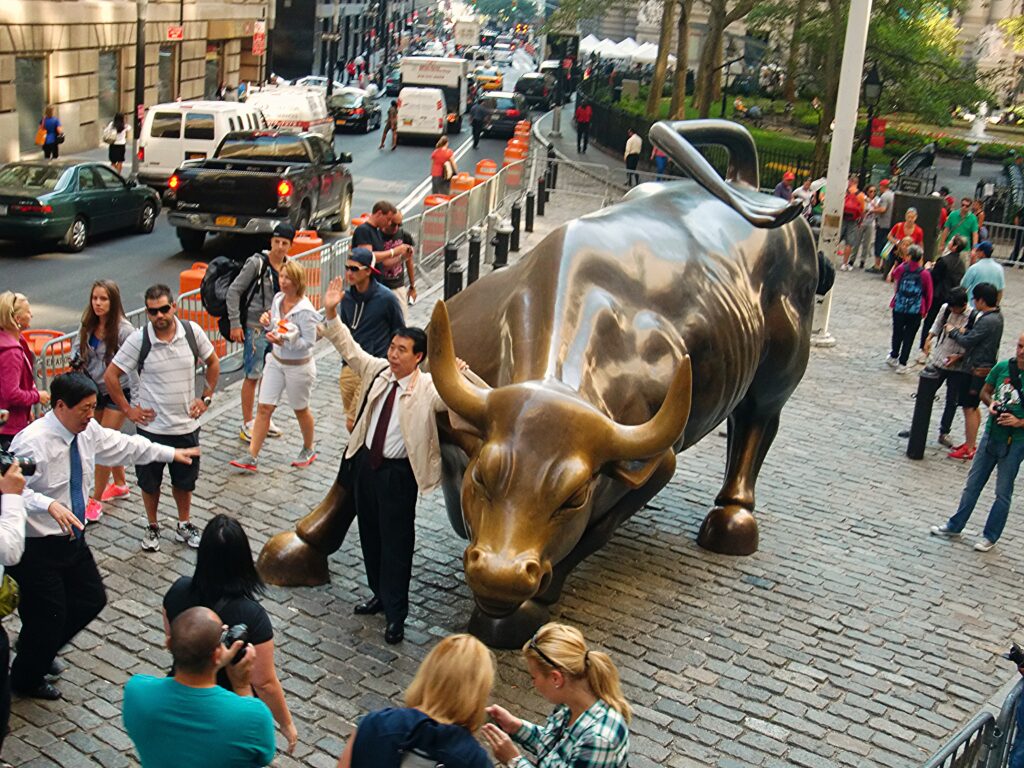
Image Source: “Charging Bull (Wall Street Bull)” by Eric Lumsden, CC BY-ND 2.0
I was just recently assessing a trip to Manhattan. It would have been an exercise in burning cash, paying for premium hotels, services, food, and experiences. When in New York… do as the tourists do, taking advantage of the lifestyle the locals cannot quite lead. For better or worse, stock market volatility introduced a better use for the money so I decided to suspend the trip.
That’s the beauty of tourism, it can wait. If I do not like the mayor of New York City, I do not have to visit. If I am worried about instability, I can wait it out. If I want to maximize my experience, I am not going to visit when the city is unclean. Having a Mamdani in office drastically decreases the probability of people like me visiting. Electing him was almost insulting. If New York does not want my money, I will not bring it. The city has done an extremely poor job at keeping up appearances and will naturally pay for it.
Admittedly, most people are not like me. If the city is able to stay out of the news, the majority of tourists will not care who the mayor is. But each piece of negative publicity will spread concerns. Instances of crime, civil unrest, protesting, economic failures, and antisemitism will cause your average person to think twice about visiting. Volunteer tourism sensitivity will have substantial economic effects, even in the short term. New Yorkers reliant on hospitality for employment are likely to take the brunt of the force.
Bearish Finance, Long Tech
“The difference between Finance and Tech is that the Finance people are smart enough to be greedy but not smart enough to be useful” – Unattributed saying popular among tech leaders.
Personally, I think the difference between finance and tech people is that finance people place more value on the history of their profession and tech people place more value on the future of theirs. But the above quote illustrates the talent war between the industries. Where are young and ambitious people to put their chips? Wall Street or Silicon Valley? When the cities of the past are insistent on tearing themselves apart, we begin to look to the cities of the future. If you want a fast track to New York, the Ivys of the East are a great way to get your foot in the door. Today, I see much more value coming out of Stanford than I do coming out of Harvard.
As New York sets itself up for failure, tech will be the winner. Finance as a profession is destined to shrink and consolidate. The fundamentals of the field are relatively simple and, in a world of AI, will require less and less human capital. In comparison, the AI buildout and the investment going into it necessitate a migration of talent. AI as a tool will unlock new opportunities, expanding the breadth of the tech industry. As wealth consolidates around it, the importance of legacy cities like New York will continue to diminish for the businesses that remain.
As our political process reaches its late stage, it appears that the libertarian roots of tech are on resurgence and the industry may be the key to finally letting people vote with their feet.
Primary Image Source: “Zohran for Mayor” by Eden, Janine and Jim, CC BY 2.0